


“This kitchen was a long process; layered, intentional, and deeply personal. I poured everything I had into it, not only as a designer, but as an artist shaping space the way I believe it should be lived in.” — Demmi Adelina Nunn, Adelina Interiors
A microcement kitchen can transform a functional space into a warm, seamless architectural environment where texture becomes part of the design itself. For a designer, creating a home for a client is one thing. Designing your own is something entirely different.
After hundreds of projects using Meoded plasters and Lime Wash to create beautiful, textural spaces for her clients, Demmi of Adelina Interiors finally had the opportunity to turn that same creative perspective inward. The opportunity, however, arrived unexpectedly: a plumbing incident forced a renovation of her personal kitchen and gave her the chance to completely reconsider the heart of her own home.
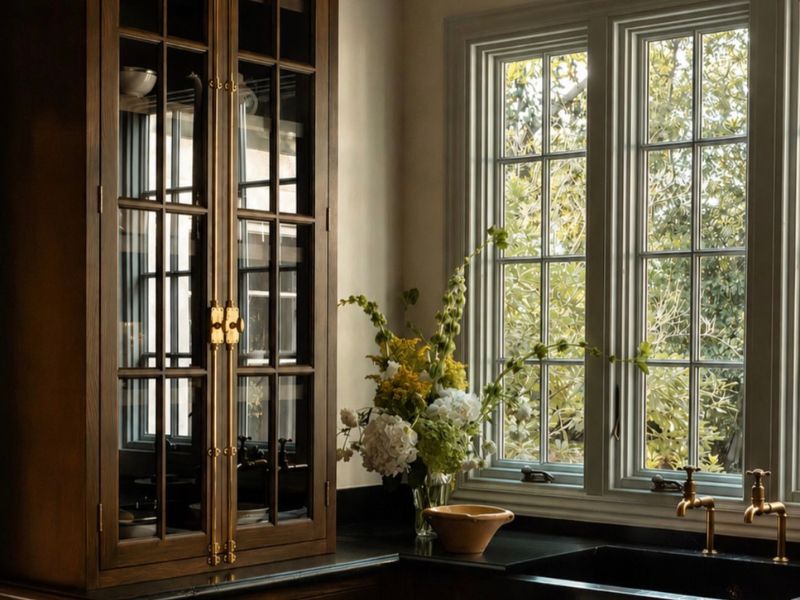
The result is a warm, restrained and deeply personal kitchen that captures everything Adelina values in design: natural texture, thoughtful proportions, enduring materials and an atmosphere meant to be lived in.
The kitchen, featured in the September 2026 issue of House & Garden UK, is enveloped in Meoded Concretta Microcement Plaster in Bone, creating a seamless, mineral-rich backdrop with subtle Mediterranean influence.
Rather than treating plaster as an accent, Adelina allowed it to become part of the architecture itself.
“Every space was studied with purpose – how it breathes, how it functions, how it holds life. Every material was selected with care for its honesty, its texture, and its ability to feel timeless rather than trend-driven.”
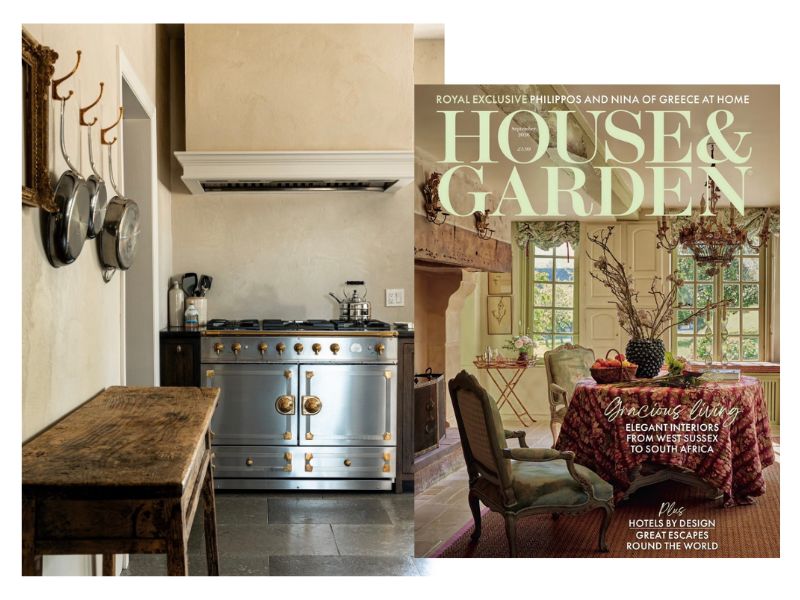
Mediterranean kitchen design has always celebrated materials that feel connected to the earth: stone, plaster, wood, metal and beautifully imperfect handcrafted surfaces.
But today’s interpretation of Mediterranean design is becoming quieter.
Rather than leaning heavily into rustic motifs or overly themed details, modern Mediterranean kitchens often take their cues from the architecture itself. Softly textured plaster walls, warm neutral colors, sculptural forms and natural materials create rooms that feel collected rather than decorated.
Adelina’s kitchen captures this sensibility beautifully.
The subtle movement of Concretta microcement plaster gives the walls depth without overwhelming the room. Instead of pattern or dramatic color becoming the focal point, light moving across the hand-applied plaster creates its own quiet variation throughout the day.
It is an approach that feels relaxed and organic while remaining sophisticated.
And at the center of the palette is one particularly important decision: Bone.
Choosing a neutral does not mean choosing a color without personality.
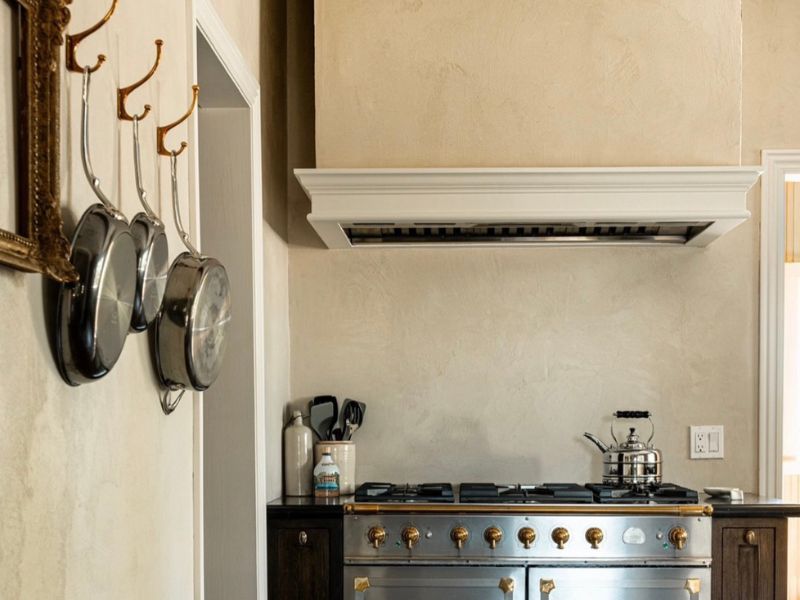
Meoded Bone is a warm, natural neutral that allows the character of the plaster itself to take center stage. Rather than feeling stark or overly cool, it creates a soft foundation for wood, stone, metals and the everyday objects that accumulate naturally in a kitchen.
This is particularly important when designing with plaster.
Unlike conventional flat paint, a hand-applied plaster finish interacts with light. Slight variations created during application give the surface depth and movement, allowing even a restrained neutral to feel nuanced.
The result is an effortless backdrop that can evolve as the home does.
Cabinetry can change. Lighting can change. Furniture, hardware and accessories can change. A beautifully selected architectural neutral has the ability to remain.
That longevity reflects Adelina’s broader philosophy.
“It reflects how I see design: free, but never careless. Intentional, but never rigid. Rooted in quality that doesn’t just photograph beautifully today, but continues to feel right for years to come.”
Kitchens ask more from their surfaces than almost any other room in the home.
They are gathering spaces and workspaces simultaneously. Walls and architectural surfaces have to coexist with moisture, cooking, cleaning and the constant rhythm of daily life.
That makes microcement plaster particularly compelling for kitchen design.
Microcement is a thin, mineral-based decorative coating designed to create a continuous surface with the organic variation of hand-applied plaster and the performance characteristics needed for more demanding spaces.
Meoded Concretta FS combines lime and cement in a natural microcement plaster formulated for durability, breathability and excellent adhesion. It can be used on interior and exterior surfaces and is particularly well suited to areas such as kitchen walls, backsplashes and countertops when installed and sealed according to Meoded’s specifications.
Visually, it offers something conventional paint and tile cannot: continuity.
Instead of interrupting the room with repeating grout lines or a traditional backsplash pattern, microcement can allow surfaces to flow into one another. That uninterrupted quality is one reason it works so beautifully within Mediterranean, organic modern, minimalist and contemporary kitchen design.
The material becomes part of the architecture rather than simply a decorative layer placed on top of it.
One of the defining elements of Adelina’s kitchen is the decision to allow plaster to surround the space rather than stopping it arbitrarily at the walls.
Plaster-drenching takes the idea of color-drenching further by using a continuous fine finish across multiple architectural planes, often including the walls and ceiling.
And the ceiling matters.
When investing in a beautiful hand-applied plaster, stopping at the ceiling line can create a visual break precisely where continuity would make the room feel more expansive and intentional.
Walls receive light vertically; ceilings catch and diffuse it horizontally. As daylight changes, the subtle movement within the plaster becomes part of the experience of the room. Carrying the plaster finish throughout the space, including the ceiling or “5th wall”, making it visible from different angles adds depth and a sophisticated design style. In a warm neutral such as Bone, that effect can be particularly beautiful.
Instead of making a room feel heavy, a light neutral plaster-drenched ceiling can soften its boundaries. The eye isn’t immediately told where the “feature finish” ends. Walls and ceiling begin to read as one architectural envelope.
For Mediterranean kitchen design especially, this creates the feeling of a space that was formed rather than decorated.
There is a consistency to Adelina Interiors’ work that extends beyond a particular color palette or design style.
Adelina carefully considers how color and texture will actually live in a home.
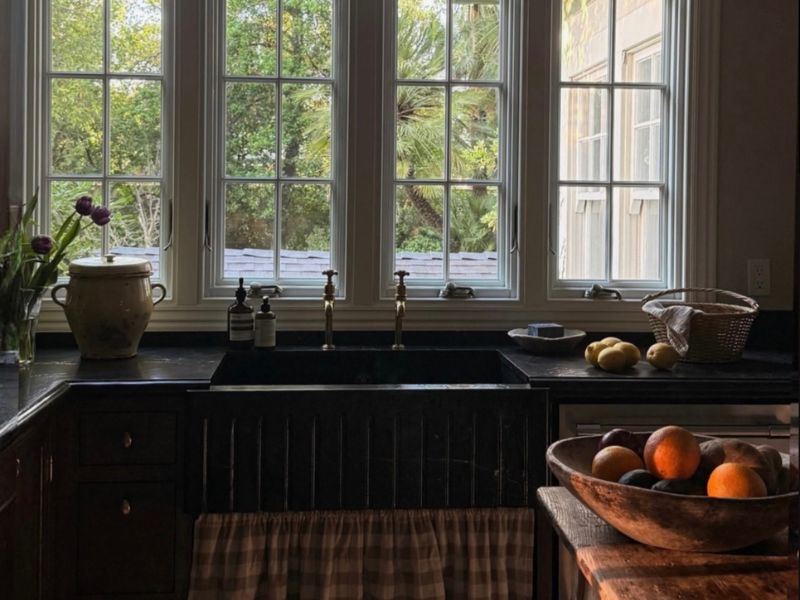
Materials need to be beautiful, but they also need to feel welcoming. Finishes need to create visual interest without becoming exhausting. And surfaces selected for hardworking rooms need to make sense beyond the photograph.
After working with Meoded Lime Wash and plasters across hundreds of client projects, redesigning her own kitchen offered Adelina a unique opportunity to apply those principles without compromise.
This time, she wasn’t simply imagining how a client might experience the room.
She would be living in it herself.
“Nothing here was rushed or accidental. Every proportion was questioned, every surface considered for how it would catch light, age, and be experienced over time.”
That distinction can be felt throughout the kitchen.
Concretta in Bone doesn’t demand attention. It rewards it.
Its warm neutral color provides calm. Its hand-applied movement brings depth. And its mineral character prevents the restraint of the palette from ever feeling flat.
The kitchen feels finished without feeling overly designed—the kind of space that can accommodate daily life without losing the qualities that made it special in the first place.
The most memorable kitchens aren’t always those with the most dramatic materials.
Sometimes they are the rooms where materials have been given enough space to reveal themselves.
Adelina describes her kitchen as “a study in restraint, detail, and meaning.”
That philosophy feels particularly relevant at a moment when kitchen trends can move remarkably quickly.
A distinctive backsplash pattern can date. A fashionable color can suddenly become associated with a particular year. Highly specific decorative elements can begin to dictate everything around them.
Natural textures and thoughtful neutrals behave differently.
They create a foundation.
“This is more than a kitchen to me—it’s a study in restraint, detail, and meaning. A reminder that when you remove what is unnecessary, what remains is allowed to speak for itself.”
Here, what remains is texture, proportion, warmth and materiality.
And perhaps that is why this kitchen feels both current and difficult to place within a single trend.
It was designed to be lived in longer than a trend cycle.
Adelina’s personal kitchen demonstrates what happens when material, color and architecture are allowed to work together.
There is no single decorative element responsible for its character.
Instead, Concretta microcement plaster in Bone creates a quiet continuity throughout the room—a warm, tactile envelope that complements the kitchen rather than competing with it.
It’s Mediterranean-inspired without becoming thematic. Minimal without becoming cold. Neutral without becoming ordinary.
Most importantly, it reflects the person who created it.
For designers and homeowners considering microcement plaster for a kitchen renovation, Concretta offers the opportunity to move beyond conventional painted walls and tiled surfaces and create something more continuous, tactile and architectural.
Explore Meoded Concretta Microcement Plaster, discover the full Meoded color collection, or contact your local Meoded dealer to begin planning your own plaster kitchen.
Design: Adelina Interiors
Featured Finish: Meoded Concretta
Color: Bone
Featured in: House & Garden UK, September 2026
Adelina Interiors is driven by a deep passion for creating stylish and functional spaces. Demmi and her team specialize in both residential and commercial interiors. articulating a unique story of one’s point of view. Transforming spaces into unforgettable experienThey create captivating and synchronized environments that are the perfect alchemy of design and bespoke textured finishes.
For experienced and advanced DIYers who already have confidence working with trowels, decorative finishes and careful surface preparation, Concretta can be an exciting material to master.
However, microcement application is a craft.
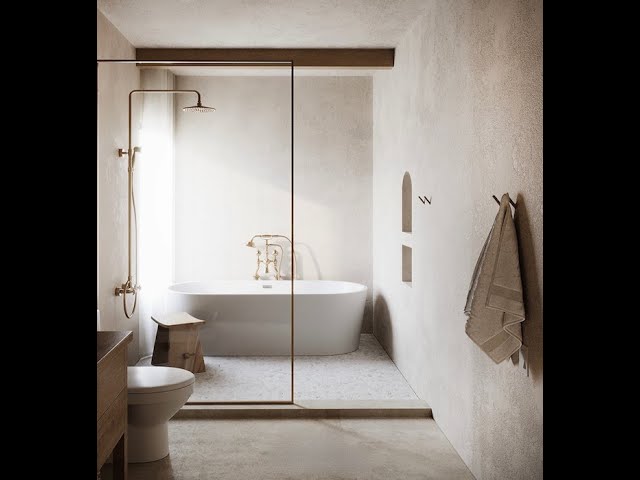

For that reason, Meoded recommends professional installation for most homeowners, particularly for large-scale applications, wet areas or projects where achieving a refined, continuous finish is essential. A Meoded dealer near you can often recommend a local, plaster or microcement applicator.
A skilled plaster applicator doesn’t simply put material on a wall. The movement created by the trowel, the pressure of each pass and the way one section transitions into another become part of the final design.
For advanced DIYers ready to take on the challenge, always follow Meoded’s current Concretta preparation, application, curing and sealing specifications before beginning.
One of the most practical advantages of Meoded Concretta microcement plaster becomes apparent during renovations.
An existing tiled surface doesn’t necessarily have to come out.
Concretta was formulated with superb adhesion and can be applied directly over properly prepared existing tile and stone without primer, eliminating one of the most disruptive stages of many traditional renovations.
For homeowners and designers updating an older tiled kitchen or backsplash, this opens up exciting possibilities.
Rather than automatically demolishing a perfectly stable tile wall, hauling away debris and rebuilding the substrate, a qualified applicator may be able to prepare the existing surface and transform it with Concretta.
The finished result is remarkably different from the surface underneath: seamless, textural and contemporary, with the handcrafted character of mineral plaster.
Proper preparation is still essential. Existing tile or stone must be stable, clean and free of loose material, and Meoded recommends lightly sanding the surface to improve adhesion. Fiberglass mesh may also be incorporated for additional reinforcement when applying over tile.
It is less about simply “covering tile” and more about reimagining an existing surface with an entirely new architectural finish.
Microcement Plaster for Kitchen Renovations
Why Choosing Concretta Microcement over Tadelakt is a Good Choice
Moroccan Clay vs Concretta: Which Textured Finish to Choose
3 Reasons Top Designers Love Meoded Concretta
Plaster Ceilings: Rethinking the 5th Wall
Q: Is microcement plaster a good choice for kitchens?
A: Yes. Microcement plaster is an excellent choice for modern kitchen design because it creates a seamless, durable surface with the natural movement and handcrafted character of plaster. It can be used on kitchen walls, backsplashes, countertops, ceilings and other architectural features, depending on the specific microcement system. Its grout-free appearance works particularly well in Mediterranean, organic modern and minimalist kitchens where continuous surfaces and natural texture are part of the design.
Q: Can microcement plaster be applied directly over existing kitchen tile?
A: Yes, certain microcement systems can be applied over existing tile when the substrate is sound and properly prepared. Concretta FS Microcement Plaster by Meoded is specifically formulated with superb adhesion and can be applied directly over properly prepared tile and stone without primer. This makes it especially appealing for kitchen renovations because homeowners may be able to transform an outdated tile backsplash or countertop without the extensive demolition required for traditional replacement.
Q: Is microcement waterproof and stain-resistant enough for a kitchen backsplash or countertop?
A: Microcement itself should not automatically be considered waterproof; its performance depends on the complete system, including proper preparation and sealing. In kitchens, a high-quality sealer helps protect microcement from water, cooking splashes, stains and everyday wear. Countertops and other horizontal surfaces require particular attention because they receive more frequent water and abrasion exposure than walls. Always follow the manufacturer’s specified sealing system for the particular microcement product and application.
Q: How durable is microcement plaster in a kitchen?
A: Properly installed and sealed microcement is a durable decorative finish well suited to everyday kitchen environments. Meoded Concretta FS Microcement Plaster is designed for demanding areas including backsplashes and countertops and provides a seamless alternative to traditional tile. Like other premium architectural finishes, it should still be cared for properly: clean spills promptly, avoid harsh or abrasive cleaners, protect countertops from direct high heat, and reseal the finish according to the manufacturer’s recommendations.
Q: Can I DIY a microcement kitchen, or should I hire a professional plaster applicator?
A: Experienced DIYers who are already comfortable with trowel-applied finishes may be able to complete smaller microcement kitchen projects, but microcement is generally not considered a beginner DIY finish. Proper substrate preparation, mixing, trowel technique, application thickness, curing and sealing all affect the final appearance and long-term durability. For countertops, large backsplashes, full plaster-drenched kitchens and other highly visible or high-use surfaces, hiring an experienced professional plaster applicator is typically the best way to achieve a refined, seamless finish.